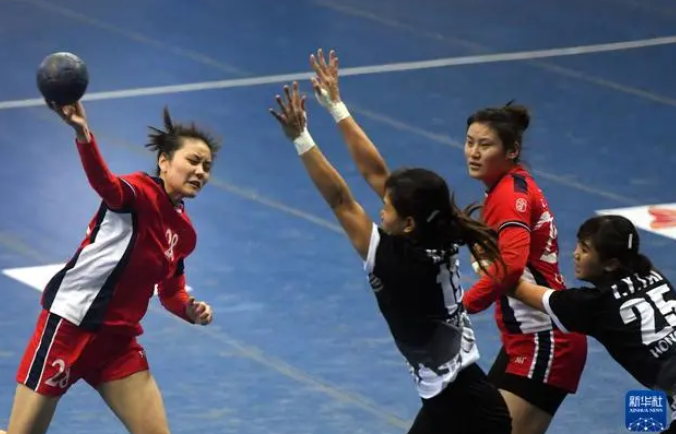
Handball
Introduction
Handball is a fast-paced team sport that combines elements of soccer and basketball, played on a rectangular court with goals at either end. It is characterized by two teams, each aiming to score by throwing a spherical ball into the opposing team's goal.
Origins and History
Handball has its roots traced back to ancient civilizations, although the modern version originated in Europe in the late 19th century. Various European countries began developing their own versions of the game, with the sport gaining official recognition in the early 20th century. The first set of codified rules was established in Denmark in 1906 by Holger Nielsen, a Danish gym teacher.
Handball was first introduced to the Olympics in 1936, making its debut at the Berlin Olympics that year. Men's 11-a-side handball was featured as an official event during this initial appearance. However, after its inauguration, handball faced intermittent inclusion in the Olympic program and underwent a format change. It wasn't until the 1972 Munich Olympics that handball returned as an official Olympic event, this time in the form of indoor handball with seven players per team.
Women's handball entered the Olympic stage four years later at the 1976 Montreal Olympics. Since then, handball has become a consistent fixture in the Olympic program, with both men's and women's competitions held every four years. The sport has garnered a dedicated following and continues to showcase thrilling matches and exceptional athleticism on the global stage during the quadrennial Olympic Games.
Rules and Gameplay
Handball is played on a court 40 meters long and 20 meters wide, with a goal in the center of each end. Each team consists of seven players: six outfield players and one goalkeeper. The main objective is to score goals by passing the ball between players and attempting to throw it into the opposing team's goal. The team with the most goals at the end of two thirty-minute halves wins the game.
Players can pass, catch, dribble, and shoot the ball using their hands. Dribbling is similar to basketball but less emphasized. Physical contact is allowed, but players must not endanger opponents with overly aggressive actions.
Technical Aspects and Skills
Handball requires a unique set of skills, combining speed, agility, and precision. Players must be adept at passing and catching the ball under pressure, executing quick movements and tactical plays. Goalkeepers play a crucial role in defense, with the ability to read opponents' intentions and react swiftly to block shots.
Training and Development
Training for handball involves a mix of physical conditioning, skill development, and strategic understanding. Players often engage in drills to improve their ball-handling abilities, shooting accuracy, and defensive positioning. Successful teams often have a blend of individual talent and cohesive teamwork, underpinned by a clear tactical plan from their coaching staff. Photo Gallery(2 pictures)CategoriesSports and GamesTagModern SportsTraditional SportsCatalogue1. Introduction2. Origins and History3. Rules and Gameplay4. Technical Aspects and Skills5. Training and Development- - - []








