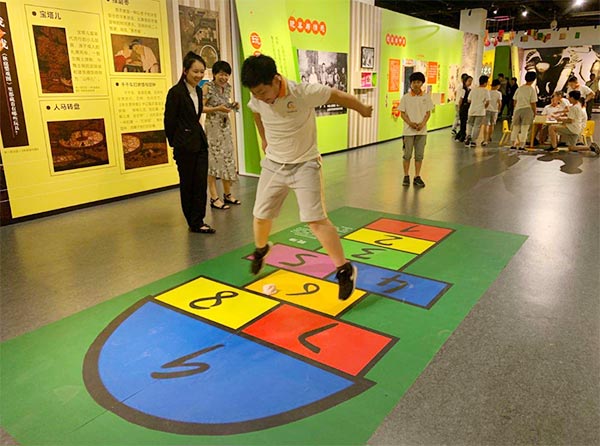
Hopscotch
Introduction
Hopscotch is a traditional children's game that has been cherished across cultures for its simplicity and accessibility. Requiring only a piece of chalk, a relatively flat surface, and a small object like a stone or tile, hopscotch is a game that encourages physical activity, coordination, and strategic thinking. Players must navigate a series of numbered squares or rectangles drawn on the ground, hopping on one foot to retrieve the object without losing balance or stepping outside the designated lines. This delightful pastime is not bound by complex rules or expensive equipment, making it a universal game that can be enjoyed by children of all ages. Its enduring popularity reflects its ability to adapt to various cultural contexts while remaining a joyful and engaging activity for generations.
Rules and Gameplay
Basic Rules
In its most basic form, hopscotch consists of a series of squares or rectangles, typically numbered from one to nine, drawn on the ground. At the top of the sequence is often a semicircle or another geometric shape, which serves as the final destination. Players take turns throwing a small object, such as a stone or tile, onto the numbered spaces in sequential order. The goal is to complete the course by hopping on one foot to retrieve the object without losing balance or stepping on the lines. If a player successfully completes the round, they continue to the next number. If they falter, their turn ends, and the next player takes over. These simple rules make hopscotch an easy and fun game for children to learn and play.
Variations
Throughout its history, hopscotch has seen numerous variations, each reflecting the cultural influences and creative imaginations of its players. Some versions incorporate additional rules, such as requiring players to use different hopping techniques or perform specific actions upon reaching certain spaces. In other variations, the number of squares or their arrangement may differ, creating unique challenges. For instance, some cultures play a version with a spiral layout, while others include obstacles or incorporate team elements. These variations add diversity to the game, ensuring that each iteration remains engaging and fresh. Despite these differences, the core principles of balance, coordination, and strategic planning remain central to the hopscotch experience.
Hopscotch in Popular Culture
Hopscotch has made its presence felt in various forms of popular culture, from literature and film to music and art. It has appeared in numerous children's books as a symbol of play and innocence, often serving as a backdrop for stories that explore themes of friendship and adventure. In films and television, hopscotch scenes are frequently used to depict youthful exuberance or to evoke nostalgic memories of childhood. The game has also inspired musicians and artists, who have drawn upon its imagery to convey themes of nostalgia, simplicity, and the passage of time. Through these cultural expressions, hopscotch continues to capture the imagination and hearts of people worldwide.








