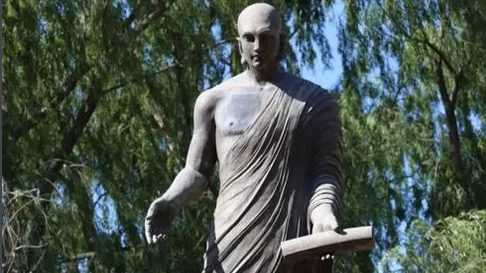
Kumarajiva
鸠摩罗什
- 分类: 哲学思想
- ID: 1867142892710838273
Home CategoryChinese PhilosophyKumarajivaPlay4.5 minsKumarajiva, born in 344 CE in Kucha (now Xinjiang, China), was the son of an Indian Hindu father and a Kuchan princess. This multicultural heritage influenced his philosophical pursuits, blending Buddhist and Hindu teachings.ShareCatalogue1. Early Life and Background2. Journey to Prominence3. Role in Buddhism and Translation Work4. Contributions to Chinese Buddhism5. The Dance Drama An Individual Soliloquy6. Cultural Impact
Early Life and Background
Kumarajiva was born in 344 CE in the ancient kingdom of Kucha, a region now part of the Aksu prefecture in the Xinjiang Uygur autonomous region of China. He was the son of a Hindu father from India and a princess from Kucha. This diverse lineage not only enriched his cultural perspective but also played a significant role in his later philosophical endeavors. Growing up in a multicultural environment, Kumarajiva was exposed to both Buddhism and Hinduism, which shaped his understanding and interpretation of religious texts.
Journey to Prominence
Kumarajiva's early education was under the guidance of his mother, who was a devout Buddhist. At a young age, he demonstrated an exceptional aptitude for learning, particularly in Buddhist scriptures. His journey toward becoming a revered Buddhist scholar began with his travels to Kashmir and other parts of India, where he immersed himself in the study of Mahayana Buddhism. These travels were pivotal in his development, as they provided him with a comprehensive understanding of Buddhist doctrines and philosophies.
Role in Buddhism and Translation Work
Kumarajiva is best known for his monumental work of translating Buddhist texts from Sanskrit into Chinese. This undertaking was not just a linguistic exercise but also a cultural and philosophical bridge that introduced and solidified Buddhist teachings in China. His translations, characterized by clarity and fidelity to the original texts, included significant sutras such as the Lotus Sutra and the Diamond Sutra. These translations played a crucial role in the spread of Mahayana Buddhism throughout China and influenced countless generations of scholars and practitioners.
Contributions to Chinese Buddhism
Kumarajiva's work significantly shaped Chinese Buddhism, particularly in how Buddhist doctrines were understood and practiced. His translations emphasized the core tenets of Mahayana Buddhism, making complex philosophical ideas more accessible to Chinese audiences. Moreover, his efforts laid the groundwork for the development of Chinese Buddhist schools, such as the Tiantai and Huayan, which were heavily influenced by the texts he translated.
Kumarajiva's legacy extends beyond his lifetime, as his translations continue to be revered as authoritative renditions of Buddhist scriptures. His work not only facilitated the integration of Buddhism into Chinese culture but also contributed to the broader Silk Road cultural exchanges between East and West. The synthesis of ideas that he fostered helped to create a rich tapestry of religious and philosophical thought that continues to resonate in modern times.
The Dance Drama An Individual Soliloquy
In recent years, the story of Kumarajiva has been brought to life through artistic expressions such as dance. Chinese dancer-choreographer Wang Yabin's production, An Individual Soliloquy, is a dance drama that chronicles Kumarajiva's journey across China via the Silk Road. Premiering at the Tianqiao Performing Arts Center in Beijing, the production is part of Wang's annual project, "Yabin and Her Friends," which aims to bring together Chinese and international choreographers to create innovative dance pieces.
Wang collaborated with Japanese dancer-choreographer Shintaro Hirahara for "An Individual Soliloquy." The production juxtaposes historical and modern interpretations of Kumarajiva's journey, illustrating his timeless influence. Hirahara's involvement underscores the international collaborative spirit that has characterized Wang's work, adding a layer of global artistic dialogue to the portrayal of Kumarajiva's life and legacy.
Cultural Impact
The dance drama not only pays homage to Kumarajiva's historical significance but also highlights the enduring impact of cultural exchange facilitated by the Silk Road. Through the medium of dance, audiences are invited to explore the intersections of history, religion, and modernity, reflecting on the ways in which ancient narratives continue to shape contemporary cultural landscapes. Article reference1. Silk road soliloquy. chinadaily.com.cn. 2018Photo Gallery(7 pictures)CategoriesChinese PhilosophyTagHistorical FiguresAncient Chinese HistoryRelatedThe Lotus SutraMaiji Mountain GrottoesCatalogue1. Early Life and Background2. Journey to Prominence3. Role in Buddhism and Translation Work4. Contributions to Chinese Buddhism5. The Dance Drama An Individual Soliloquy6. Cultural Impact- - - []








