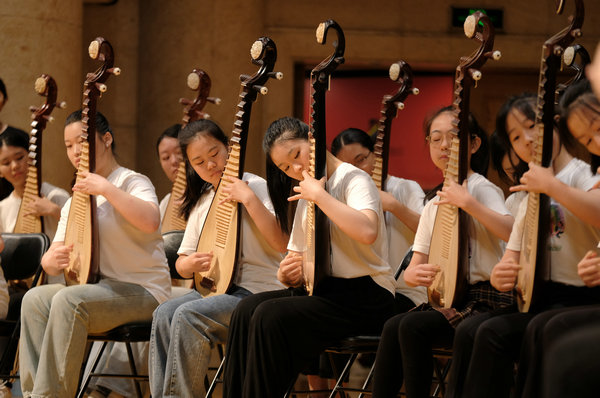
Pipa
Introduction
The pipa, a traditional Chinese stringed instrument with over 2,000 years of history, is renowned for its expressive range and cultural significance. It is a lute-like, four-stringed instrument that features a distinctive pear-shaped body and a fretted fingerboard. Played either with the fingers or a plectrum, the pipa holds a prominent position in Chinese musical heritage, offering a unique blend of melodious and percussive sounds. Its versatility allows it to perform a wide range of music genres, from classical and folk music to contemporary experiments with jazz, rock, and electronic music.
History
The pipa has a rich history that dates back over two millennia, with its origins tracing back to the Qin Dynasty (221-206 BC). Initially influenced by foreign lute-like instruments from Central Asia, the pipa evolved significantly during the Han Dynasty (206 BC-AD 220) and Tang Dynasty (618-907), becoming a core component of Chinese musical culture. The instrument gained popularity in the Tang Dynasty court, where it was played by skilled musicians and celebrated in poetry. Over the centuries, the pipa underwent numerous transformations in design and playing techniques, contributing to its enduring appeal in both traditional and modern contexts.
Construction and Design
Materials
The pipa is traditionally crafted from several types of wood, including rosewood, blackwood, and red sandalwood. These materials are chosen for their resonance and durability, ensuring a rich, full-bodied sound. The strings were historically made from silk but have been replaced by nylon-wrapped steel strings in modern times for enhanced brightness and longevity. The delicate balance of these materials contributes to the pipa's distinctive timbre, allowing it to produce a wide range of expressive tones.
Structure
The pipa's design is characterized by its pear-shaped body and a long neck with a fretted fingerboard. Typically, it features four strings, though variations with more strings can be found. The fingerboard consists of 30 frets, allowing for a wide range of notes and complex melodies. The instrument's body is hollow, with a soundboard that amplifies the vibrations of the strings. The combination of the instrument's structure and materials gives the pipa its unique sound, capable of both subtle, delicate melodies and powerful, dramatic expressions.
Playing Techniques
Finger Techniques
Pipa players employ a variety of finger techniques to achieve the instrument's dynamic range and expressiveness. These techniques include plucking, strumming, and flicking the strings with the fingernails or a plectrum. The left hand is used to press down on the strings along the frets, allowing for pitch variation and vibrato. Common techniques include "tremolo," where rapid, repeated plucking is executed to create a continuous sound, and "bending," which alters the pitch by pushing or pulling the strings across the frets.
Plucking Styles
Pipa musicians utilize diverse plucking styles to create different tonal effects. The "sweeping" technique, for example, involves quickly running the fingers across all strings, producing a cascading sound. "Rolling" involves a rapid succession of notes played with a flick of the fingers. These techniques, combined with the expressive use of dynamics and tempo, allow pipa players to convey a wide range of emotions and narratives through their music.
Repertoire
The pipa's repertoire spans traditional Chinese compositions, modern adaptations, and cross-cultural collaborations. Classic pieces such as Ambush from Ten Sides and The Warlord Takes off His Armor showcase the instrument's dramatic potential. Contemporary musicians, like Wu Man, have expanded the repertoire by integrating the pipa into various musical genres, including jazz and Western classical music, thereby enriching its global appeal and demonstrating its versatility.
Notable Musicians
Several musicians have played pivotal roles in promoting the pipa both domestically and internationally. Wu Man, a distinguished pipa virtuoso, has been instrumental in expanding the instrument's reach through her collaborations with ensembles like the Kronos Quartet and Silk Road Ensemble. Her performances have captivated audiences worldwide, earning her numerous accolades and awards. Other notable musicians include Liu Dehai, whose contributions to pipa composition and education have left a lasting legacy, and Zhao Cong, known for her innovative approaches to pipa music.








