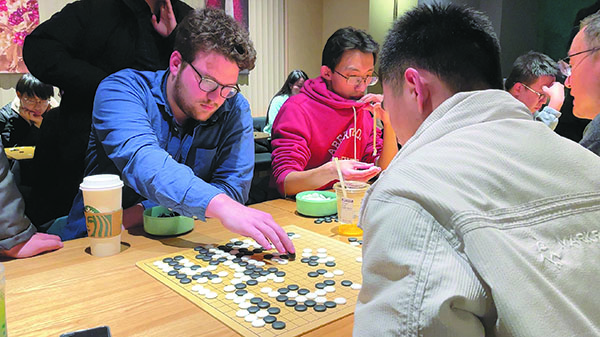
Weiqi
Introduction
Weiqi, also known as Go, is an ancient board game that holds a significant place in East Asian culture. It is a game of strategy in which two players alternately place black and white stones on the vacant intersections of a 19x19 grid. The game's objective is to control a larger portion of the board than the opponent. As a game that relies heavily on strategy, Weiqi is renowned for its complexity and the depth of its gameplay, despite having relatively simple rules. It is a game that has been played for thousands of years, with origins traced back to ancient China. Over time, it has spread to Korea, Japan, and more recently, to the rest of the world. The game challenges players to think strategically, predicting opponents' moves several steps ahead, while also reflecting profound philosophical ideas in its gameplay.
History
Origins of Weiqi
Weiqi is believed to have originated in China more than 4,000 years ago, making it one of the oldest board games still played today. Historical records and ancient writings suggest that Weiqi was initially developed as a means for divination or military strategy, before evolving into a game. The earliest written reference to Weiqi can be found in the historical annals of China, where it was mentioned in association with ancient Chinese emperors. It was during the Zhou Dynasty (c.11th century-256BC) that Weiqi began to gain popularity among the Chinese nobility and scholars, evolving into a pastime associated with intellectual and cultural refinement.
Development through the Ages
Weiqi continued to flourish and develop throughout Chinese history, reaching new heights during the Tang (618–907 AD) and Song (960–1279 AD) dynasties. During these periods, the game was heavily patronized by the ruling classes and became an integral part of the cultural life of the Chinese elite. The game was also embraced by Confucian scholars, who saw it as a means to cultivate virtue and wisdom. By the time of the Song Dynasty, Weiqi had spread beyond China's borders, reaching Korea and Japan, where it became known as Baduk and Go, respectively. Each culture added its own unique influences to the game, leading to variations in rules and terminology, but the core principles of the game remained consistent across regions.
Rules and Gameplay
Basic Rules
Weiqi is played on a square grid of 19x19 lines, although smaller boards of 13x13 and 9x9 lines are also common for beginners. Players take turns placing stones of their respective colors (black or white) on the intersections of the lines, attempting to create large areas (called "territories") and capture their opponent's stones. A stone or group of stones is captured and removed from the board if it is completely surrounded by the opponent's stones on all orthogonally adjacent points. One of the unique aspects of Weiqi is the komi rule, which gives white a set number of extra points to compensate for the advantage of going second.
Game Objective
The primary objective of Weiqi is to control more territory on the board than the opponent by the end of the game. Territory is defined as the empty points completely surrounded by stones of one color. Additionally, players aim to capture their opponent's stones by surrounding them, thereby increasing their own territory and reducing the opponent's potential control of the board. The game ends when both players consecutively pass their turns, indicating that neither player can gain any further advantage through additional moves. The winner is determined by counting the controlled territories and captured stones, with the player having the higher total declared the victor.
Strategies and Techniques
Weiqi is renowned for the depth and complexity of its strategic elements. Players must think several moves ahead and anticipate their opponent's strategies. Strategies can vary widely, from aggressive approaches aimed at capturing opponent stones to more conservative tactics focused on building and securing large territories. Advanced techniques include concepts such as "sente" (having the initiative), "gote" (responding to the opponent), and "tesuji" (skillful moves). Proficiency in Weiqi requires understanding these strategic principles and the ability to apply them effectively during gameplay.








