Fencing
Overview
Fencing is a traditional European martial art and sport that involves combat with swords. It has evolved over centuries into a competitive sport that is practiced globally. The sport is characterized by its use of three types of weapons: foil, épée, and sabre, each with its own set of rules and techniques. Fencing is not only a test of physical skill but also of strategy and mental acuity, often referred to as "physical chess" due to the emphasis on tactics and decision-making.
Historical Background
Fencing has its origins in the practice of swordsmanship for dueling and self-defense, dating back to ancient civilizations. The modern sport of fencing began to take shape in the 14th and 15th centuries in Spain and Italy, where early schools of fencing emerged. By the 17th century, fencing schools had spread across Europe, and the sport began to be systematized with rules and techniques.
In the late 19th century, fencing became an organized competitive sport with the establishment of national fencing federations and the inclusion of fencing in the first modern Olympic Games in 1896. The Fédération Internationale d'Escrime (FIE), the international governing body of fencing, was founded in 1913.
Fencing Weapons and Techniques
Fencing is conducted with three primary weapons, each with distinct rules and target areas:
-
Foil: A light thrusting weapon with a flexible, rectangular blade. The valid target area is the torso, excluding arms and legs. Foil fencing emphasizes speed and precision, with a focus on right-of-way or priority rules to determine which fencer scores a point in case of simultaneous attacks.
-
Épée: A heavier thrusting weapon with a larger, triangular blade. The entire body is a valid target area. Épée fencing is distinctive for its absence of right-of-way rules, meaning the first fencer to hit scores a point. It requires strategic planning and precise timing.
-
Sabre: A light cutting and thrusting weapon with a curved blade. The valid target area includes everything from the waist up, except the hands. Sabre fencing is known for its fast-paced action and emphasis on offensive tactics.
Fencing Competitions
Fencing competitions are organized at various levels, including club, national, and international contests. The sport is a staple of the Olympic Games, with individual and team events conducted in each weapon category. Fencing bouts are held on a specific strip called the piste, where competitors strive to outscore their opponents within a set time.
Modern Developments and Integration with Dance
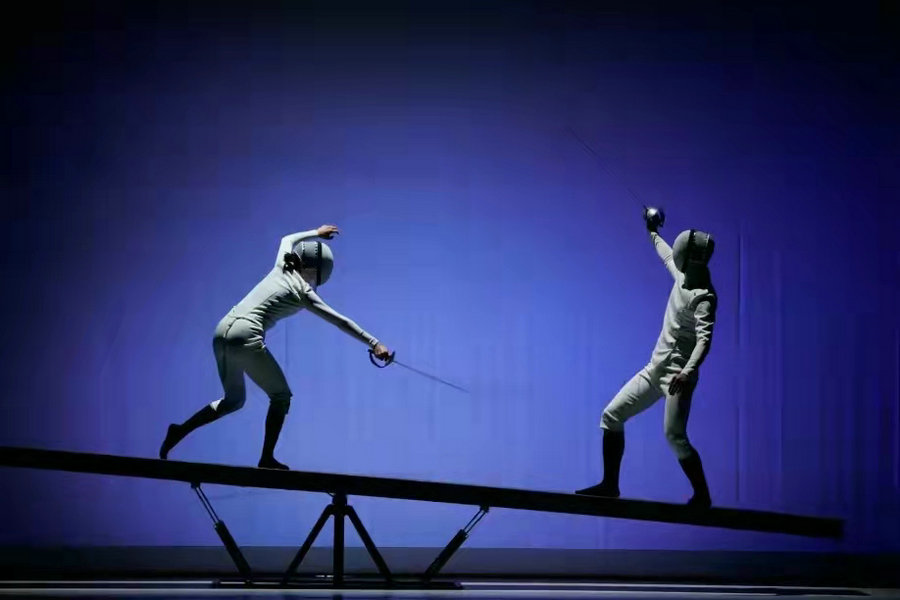
In recent years, fencing has been creatively integrated with other art forms, such as dance, to explore human themes and emotions. A notable example is the modern dance piece Disappear, choreographed by Hou Ying. This work combines fencing with modern dance to depict themes of human resilience and confrontation. It illustrates how the structured movements of fencing can be reinterpreted in a dance context, creating a unique fusion of physical expression.
The integration of fencing with dance reflects a broader trend of blending sports with the arts, highlighting the aesthetic and expressive potential of athletic movements. This innovative approach not only broadens the appeal of fencing to new audiences but also expands its artistic dimensions. Article reference1. Art in combat. chinadaily.com.cn. 2022Photo Gallery(3 pictures)CategoriesSports and GamesTagModern SportsTraditional SportsRelatedJeet Kune DoBruce LeeXu HaifengFISU World University GamesCatalogue1. Overview2. Historical Background3. Fencing Weapons and Techniques4. Fencing Competitions5. Modern Developments and Integration with Dance- - - []








